Dankzij een hernieuwde interesse in FNS is er de afgelopen jaren veel wetenschappelijk onderzoek gedaan naar FNS en is er gepubliceerd over FNS. Het leeuwendeel zijn artikelen achter een (logische) betaalmuur. Maar een deel is ook vrij te lezen. Hieronder volgt een lijst met artikelen (Engels, Nederlands en Duits) over FNS. Daarnaast staan er diverse links naar online lezingen en webinars. Alle bronnen hieronder zijn openbaar op internet te vinden of te downloaden via deze website. Bij een enkele website dien je een gratis account aan te maken.
Let op: aan de lijst wordt nog hard gewerkt!
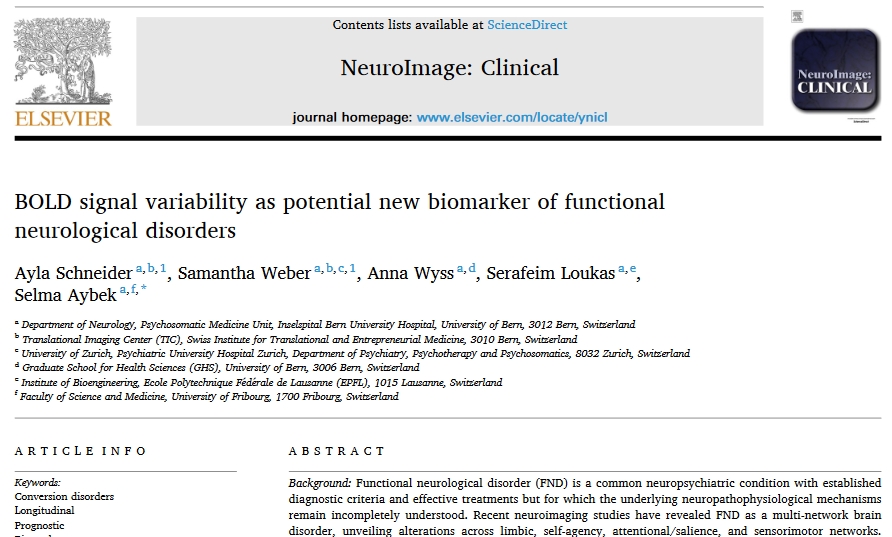
BOLD signal variability as potential new biomarker of FND
Ayla Schneider e.a.
2024
“This study contributes to the understanding of FND pathophysiology, emphasizing the dynamic nature of neural activity and highlighting the potential of BOLD signal variability as a valuable research tool. The insula and SMA emerge as promising regions for further investigation as prognostic and state markers.”
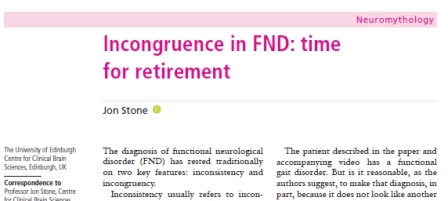
Incongruence in FND- time for retirement
J. Stone
2024
“In my view, incongruence needs retirement. It should be sent to the FND section of the neuromythology graveyard where it can join ‘la belle indifférence’, ‘non-organic’ and the universal application of ‘conversion disorder’. Here is what I object to, and find incongruent, about this sign still being used in the clinical assessment of FND.”
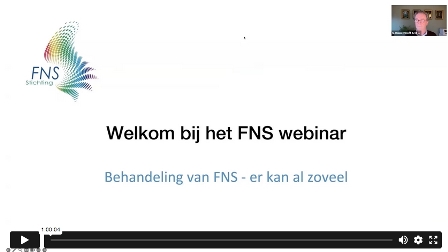
Behandeling van FNS – er kan al zoveel
Online webinar met 3 sprekers:
Barbara van Olffen (logopedist): logopedie bij FNS
Elisabeth Foncke (neuroloog): functionele aanvallen, belang van (h)erkenning
Bart van Buchem (fysiotherapeut): wat doet de fysio- of oefentherapeut met kennis over FNS anders?
2024
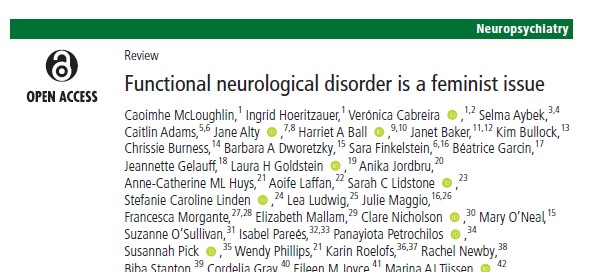
Functional neurological disorder is a feminist issue
C. McLoughlin, I. Hoeritzauer, e.a.
2023
“We outline the reasons why FND is a feminist issue, incorporating historical and contemporary clinical, research and social perspectives.
We call for parity for FND in medical education, research and clinical service development so that people affected by FND can receive the care they need.“
De rol van de Neuroloog
T. Lagrand
2023
Lezing in de serie FNS Kennissessies
In het brein van de FNS patiënt
L. Marapin
2023
Lezing in de serie FNS Kennissessies over neuroimaging.
FND historical trends and urgent directions
Yadira Velazquez & Brooke Fehily
2023
“Multidisciplinary collaboration is needed to fill current knowledge gaps, with multispecialty teams helping to overcome the deficits in outcomes and prognosis still affecting FND, one of the commonest and most expensive neurological disorders currently affecting humankind.“
A new science of emotion: implications for functional neurological disorder
J. Jungilligens, S. Parades, e.a.
2022
“They first outline a set of relevantworking principles of the brain, followed by a focused review of the theory of constructed emotion to introduce a new understanding ofwhat emotions are. Building on this theoretical framework, they formulate how altered emotion category construction can be an integral component of the pathophysiology of functional neurological disorder and related functional somatic symptoms.“
When neurologists diagnose functional neurological disorder, why don’t they code for it?
L. DoVal, R. Kim, A. Hassan e.a.
2021
“Noncoding for FND is common. Most factors that amplify noncoding also hinder face-to-face communication. Research based on ICD-10 coding (eg, prevalence and cost) may underestimate the impact of FND by >fourfold.”
Management of functional communication, swallowing, cough and related disorders: consensus recommendations for speech and language therapy
J. Baker, C. Barnett, L. Cavalli e.a.
2021
“Communication problems, swallowing disorders, cough and upper airway symptoms, resulting from FND, are commonly encountered by speech and language professionals. However, there are few descriptions in the literature of the most effective practical management approaches. This consensus document aims to provide recommendations for assessment and intervention that are relevant to both adults and young people.“
Multidisciplinaire aanpak van functionele bewegingsstoornissen
T. Lagrand, B. van Buchem, L. Marapin, e.a.
2021
“FBS zijn veelvoorkomende en invaliderende neurologische ziektebeelden met een forse impact op het dagelijks functioneren van patiënten die eraan lijden. Gezien de complexe en multifactoriële aard is het vanzelfsprekend dat er een team van verschillende specialisten betrokken is bij de behandeling van FBS.“
Functionele bewegingsstoornissen; het belang van tijdig herkennen, benoemen en behandelen
R. Marapin, J. Gelauf, M. de Koning-Tijssen
2021
“De afgelopen jaren zijn de inzichten omtrent de etiologie en pathofysiologie van FBS significant veranderd. (…) In dit artikel bespreken we de nieuwe ontwikkelingen op het gebied van de etiologie, pathofysiologie, diagnostiek en behandeling van FBS.”
Psychiatry’s modern role in FND: join the renaissance
I. Bègue, T. Nicholson, K. Kozlowska, e.a.
2021
“FND challenges the artificial divide between physical and mental health that is pervasive in healthcare and society. FND is a model disorder to understand complex brain-mind-body concepts in medical conditions.”
Systematic review of psychotherapy for adults with FND
M. Gutkin, L.McLean, R. Brown e.a.
2021
“In this paper, we systematically review the evidence for outpatient individual psychotherapy for adults with FND, with a focus on the evidence for PDT and CBT.”
How to do things with words: 2 seminars on the naming of functional (psychogenic, non-epileptic, dissociative, conversion, …) seizures
A. Wardrope, B. Dworetzky, G. Barkley e.a.
2021
“ This paper summarises two recent discussions hosted by the American Epilepsy Society and Functional Neurological Disorders Society on the naming of this condition. These discussions are conceptualised as the initial step of an exploration of whether it might be possible to build consensus for a new diagnostic label.“
“What if the patients most health professionals actively seek to avoid, people with ‘medically unexplained’ or functional symptoms, were those who hold the key to a more successful, more rewarding and more just system of medical practice for all? I think they do. They force us to answer the question, to paraphrase Wittgenstein: What is left over, if I subtract the fact that I have a disease, from the fact that I am ill?“
Functional neurological disorder and multiple sclerosis: a systematic review of misdiagnosis and clinical overlap
D. Walzl, A. Solomon, J. Stone
2021
“MS and FND are both diagnostically challenging conditions which can present with similar symptoms. We systematically reviewed the literature to identify patients with MS who were misdiagnosed with FND, patients with FND who were misdiagnosed with MS, and reports of patients with both conditions.“
The challenges of chronic pain and fatigue
J. Eccles & K. Davies
2021
“In this review, we explore the challenges of chronic pain and fatigue in clinical practice. Both pain and fatigue are common, troubling and frequently overlapping symptoms, and we describe both the clinical burden and the ‘clinical problem’.”
Neuroimaging in Functional Neurological Disorder: State of the Field and Research Agenda
D. Perez, T. Nicholson, R. Marapin, e.a.
2021
“We first briefly summarize neural circuit models of FND, and then detail the research approaches used to date in FND within core content areas: cohort characterization; control group considerations; task-based functional neuroimaging; resting-state networks; structural neuroimaging; biomarkers of symptom severity and risk of illness; and predictors of treatment response and prognosis. Lastly, we outline a neuroimaging-focused research agenda to elucidate the pathophysiology of FND and aid the development of novel biologically and psychologically-informed treatments.“
Medically unexplained symptoms: assessment and management
M. Husain & T. Chalder
2021
“Medically unexplained symptoms or persistent physical symptoms are common, real and are associated with significant distress, loss of functioning and high healthcare costs. History, examination and appropriate investigations are essential to make a diagnosis. Once the diagnosis has been made, exploring the impact of the symptoms helps us to tailor our advice to patients. This paper sets out a practical approach to taking a history, assessment and stepwise management principles.“
“Normal baseline investigation results in a patient with common symptoms is often labelled as being due to a functional disorder, with all the pejorative connotations that go along with that term. When given the opportunity to see a patient for a second opinion, it is important to retain an open mind rather than assuming previous assessments are correct.”
Drop attacks as a subtype of FND: A cognitive behavioural model using grounded theory
E. Revell, D. Gillespie, J. Stone & P. Morris
2021
“The aim of this study was to test a cognitive behavioural model of idiopathic drop attacks, in order to inform formulation and treatment. Interviews and diaries were completed by seven individuals experiencing drop attacks, and were analysed using a grounded theory qualitative data approach.”
Decade of progress in motor functional neurological disorder: continuing the momentum
D. Perez, M. Edwards, G. Nielsen, e.a.
2021
“Functional neurological disorder (FND) is a prevalent, disabling and costly condition at the neurology–psychiatry intersection. After being marginalised in the late 20th century, there has been renewed interest in this field. In this article, we review advances that have occurred over the past decade (2011–2020) across diagnosis, mechanisms, aetiologies, treatments and stigma in patients with motor FND (mFND, that is, functional movement disorder and functional limb weakness).“
“Neurological and neuropsychiatric adverse events have been reported in clinical trials of various SARS-CoV-2 vaccines and, more often, in open-label monitoring. In many cases, no definitive evidence has yet supported causality. Despite this, there are recognised rare adverse events that have been causally linked to SARS-CoV-2 vaccines, for example, VITT. The necessary ongoing surveillance work is in progress; however, the current advice that the benefit of the vaccination outweighs the risk appears to be accurate from a neurological standpoint.”
“Aim: 1) To explore the feasibility to establish and assess a cohort of CD/FND with motor symptoms, involving persons with lived experience (PPI). 2) To generate proof of concept regarding a possible role for cytokines, microRNA, cortisol levels and neurocognitive symptoms in patients with motor CD/FND.”
A practical review of functional neurological disorder (FND) for the general physician
K. Bennett, C. Diamond, I. Hoeritzauer, e.a.
2021
“The diagnosis of FND should rest on clear positive evidence, typically from a combination of physical signs on examination or the nature of seizures. In treatment of FND, clear communication of the diagnosis and the involvement of the multidisciplinary team is beneficial. We recommend that patients with FND are referred to specialists with expertise in neurological diagnosis.”
Reduced Limbic Microstructural Integrity in Functional Neurological Disorder
I. Diez, B. Williams, M. Kubicki, e.a.
2021
“Individuals with FND exhibit corticolimbic abnormalities, yet little is known about the role of white matter tracts in the pathophysiology of FND. This study characterized between-group differences in microstructural integrity, and correlated fiber bundle integrity with symptom severity, physical disability and illness duration.”
Vom Stigma der Hysterie lösen
S. Popkirov & M. Hoheisel
2020
“Patienten mit funktionellen neurologischen Störungen erleben in der Praxis oft, dass ihre Probleme nicht ernst genommen werden. Doch groß angelegte Studien und aktuelle neurowissenschaftliche Erkenntnisse lassen dieses vernachlässigte Teilgebiet der Neurologie in neuem Licht erscheinen.”
“Psychiatry training is lacking examples of neuroscience education that translates neuroscience literature into accessible clinically oriented concepts. The authors created a teaching activity using patient-centered neuroscience education that focused on delivering the diagnosis of FND. This study aimed to (i) develop a workshop modeling a clinician-patient interaction, (ii) provide a modern neuroscience perspective of FND, and (iii) evaluate the change in clinicians’ perceptions of FND.“
Occupational therapy consensus recommendations for functional neurological disorder
C. Nicholson, M. Edwards, A. Carson, e.a.
2020
“Occupational therapists have an integral role in the multidisciplinary management of people with FND. This document forms a starting point for research aiming to develop evidence-based occupational therapy interventions for people with FND.”
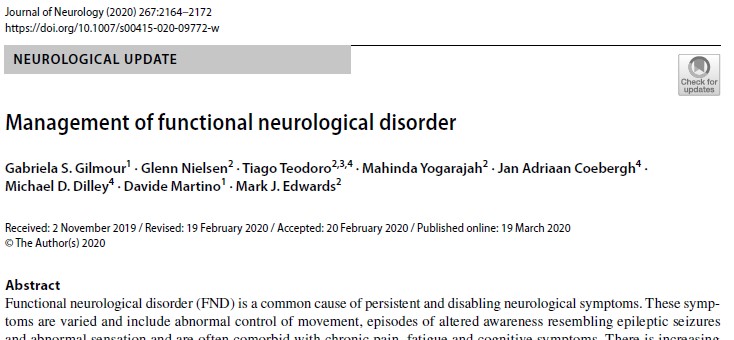
Management of functional neurological disorder
G. Gilmour, G. Nielsen, T. Teodoro, e.a.
2020
“The aim of this review is to discuss strategies for the management of FND by focusing on the diagnostic discussion and general principles, as well as specific treatment strategies for various FND symptoms, highlighting the role of the neurologist and proposing a structure for an interdisciplinary FND service.”
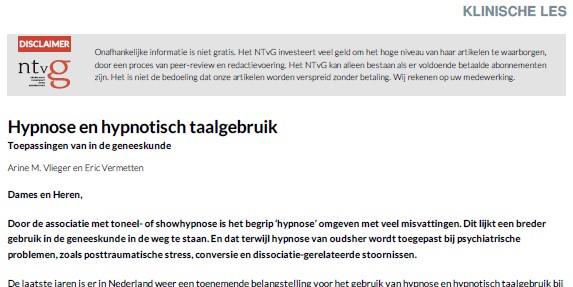
Hypnose en hypnotisch taalgebruik
A. Vlieger & E. Vermetten
2020
“Door de associatie met toneel- of showhypnose is het begrip ‘hypnose’ omgeven met veel misvattingen. Dit lijkt een breder gebruik in de geneeskunde in de weg te staan. En dat terwijl hypnose van oudsher wordt toegepast bij psychiatrische problemen, zoals posttraumatische stress, conversie en dissociatie-gerelateerde stoornissen.“
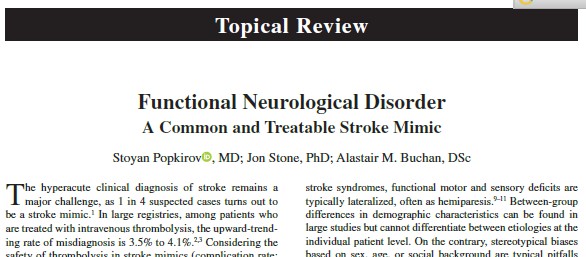
Functional Neurological Disorder, A Common and Treatable Stroke Mimic
S. Popkirov, J. Stone & A. Buchan
2020
“The hyperacute clinical diagnosis of stroke remains a major challenge, as 1 in 4 suspected cases turns out to be a stroke mimic.”
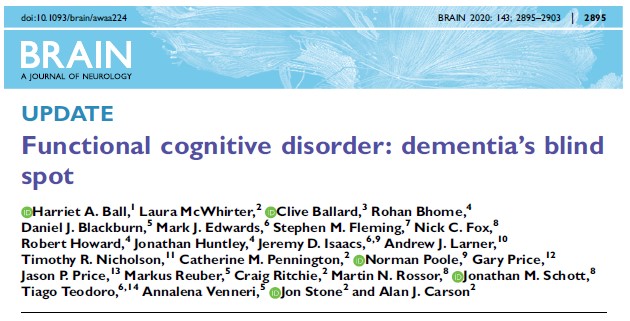
Functional cognitive disorder: dementia’s blind spot
H. Ball, L. McWhirter, C. Ballard, e.a.
2020
“An increasing proportion of cognitive difficulties are recognized to have a functional cause, the chief clinical indicator of which is internal inconsistency. When these symptoms are impairing or distressing, and not better explained by other disorders, this can be conceptualized as a cognitive variant of functional neurological disorder, termed functional cognitive disorder (FCD).“
A Review and Expert Opinion on the Neuropsychiatric Assessment of Motor Functional Neurological Disorders
D. Perez, S. Aybek, S. Popkirov, e.a.
2020
“In this article, the authors performed a narrative review to characterize clinically relevant variables across FND-movt and FND-par cohorts, including time course and symptom evolution, precipitating factors, medical and family histories, psychiatric comorbidities, psychosocial factors, physical examination signs, and adjunctive diagnostic tests. Thereafter, the authors propose a preliminary set of clinical content that should be assessed during early-phase patient encounters, in addition to identifying physical signs informing diagnosis and potential use of adjunctive tests for challenging cases.“
The prognosis of functional limb weakness: a 14-year case-control study
J. Gelauff, M. Tijssen, J. Stone, e.a.
2019
“In this study we used a prospectively recruited, controlled cohort design to assess misdiagnosis, mortality and symptomatic and health outcome in patients with functional limb weakness compared to neurological disease and healthy control subjects. One hundred and seven patients with functional limb weakness, 46 neurological and 38 healthy control subjects from our previously studied prospective cohort were traced for follow-up after an average of 14 years.”
The bladder and the brain: exploring functional urological symptoms
I. Hoeritzauer
2019
“Changing views of FND in the last 10 years mean that urological symptoms are once again being investigated as a potential part of functional disorders. Patients presenting with chronic idiopathic urinary retention, diagnosed as Fowler’s syndrome, or presenting with acute urinary retention and possible cauda equina syndrome, have been found to have high levels of functional disorder and FND comorbidity.”
Structural alterations in functional neurological disorder and related conditions: a software and hardware problem?
I. Bègue, C. Adams, J. Stone & D. Perez
2019
“In this systematic review, we use a transdiagnostic approach to review and appraise the structural neuroimaging literature in FND and SSD. While larger sample size studies are needed for definitive characterization, this article highlights that individuals with FND and SSD may exhibit sensorimotor, prefrontal, striatal-thalamic, paralimbic, and limbic structural alterations.“
Neuroimaging in Functional Movement Disorders
J. Roelofs, T. Teodoro & M. Edwards
2019
“Neuroimaging has provided new insights into functional movement disorders, supporting emerging neurobiological theories implicating dysfunctional emotional processing, self-image and sense of agency. Recent studies have also found subtle structural brain changes in patients with functional disorders, arguing against a strict functional/ structural dichotomy.”
Klinische les: Een patiënte met onverklaarde neurologische klachten
E.Maris, A. Ramdhani, A. Scholte
2019
Een case-study van een patiënte met diverse onverklaarde neurologische klachten.

D
T. L
20xx
L
Identifying motor functional neurological disorder using resting-state functional connectivity
J. Wegrzyk, V. Kebets, e.a.
2018
“Conclusions: The good accuracy to discriminate patients from controls suggests that RS FC could be used as a biomarker with high diagnostic value in future clinical practice to identify mFND patients at the individual level.“
H. Cock & M. Edwards
2018
Over de uitingsvormen en positieve diagnose.
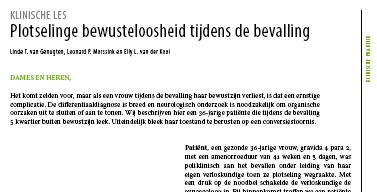
Klinische les: plotselinge bewusteloosheid tijdens de bevalling
L. van Genugten, L. Morssink, E. van der Kooi
2016
Een case-study van een patiënte die tijdens haar bevalling een FNS-aanval krijgt.
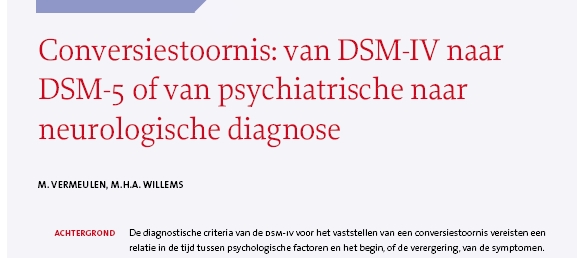
Conversiestoornis: van DSM-IV naar DSM-5 of van psychiatrische naar neurologische diagnose
Marinus Vermeulen en M.H.A. Willems
2015
De overgang in de DSM-5 naar een neurologische aandoening.
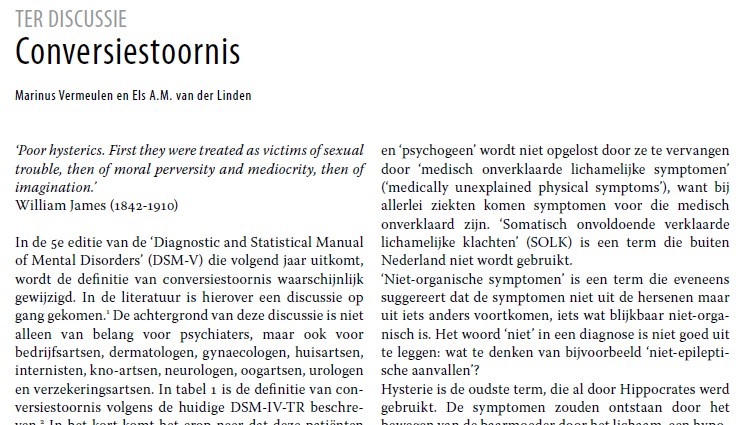
Ter discussie: conversiestoornis
M. Vermeulen en E. van der Linden
2012
“”In de 5e editie van de ‘Diagnostic and Statistical Manual of Mental Disorders’ (DSM-V) die volgend jaar uitkomt, wordt de definitie van conversiestoornis waarschijnlijk
gewijzigd. In de literatuur is hierover een discussie op gang gekomen… “

D
T. L
2023
L
I
L. M
2023
L
 Leven met FNS